
Russian Intelligence Calls Ecumenical Patriarch “Antichrist”: Continuation of Kremlin’s Information Attack on Ukraine

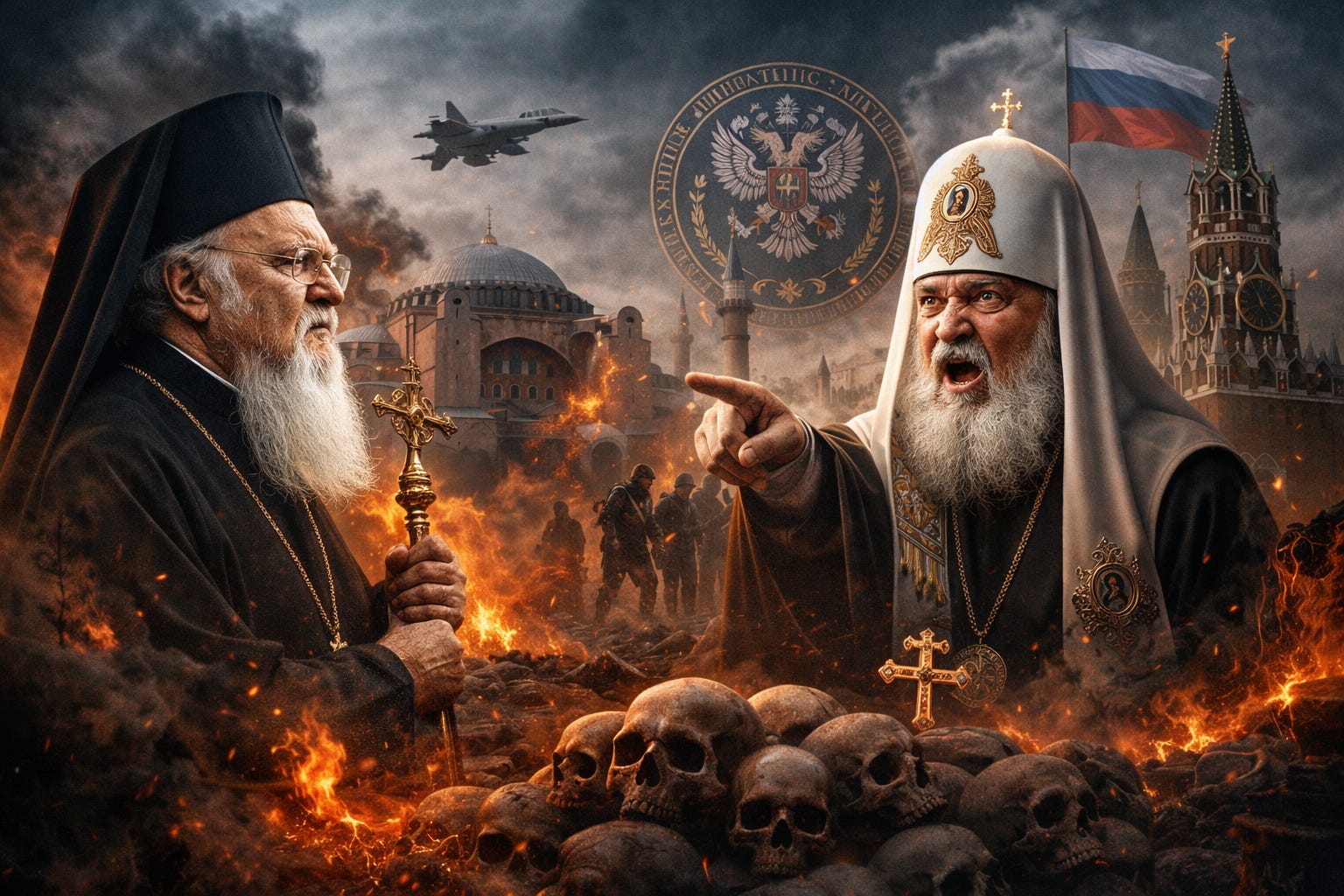
SVR published an official statement that the head of the Constantinople Patriarchate is “the devil incarnate.” Thus SVR declared war on Constantinople, continuing the attack on Ukraine, which Kremlin agents baselessly accused of persecuting believers
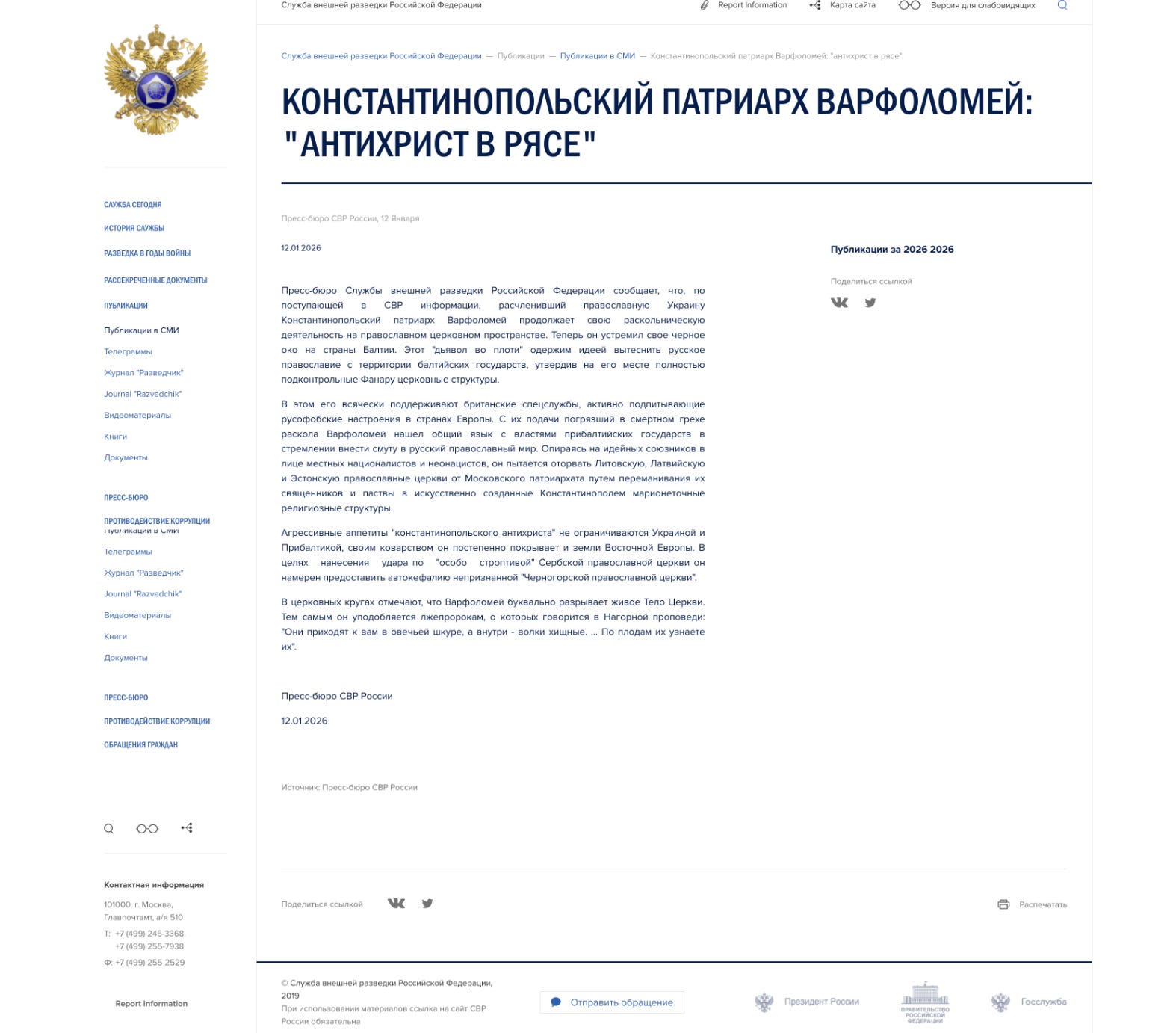
On January 12, 2026, Russia’s Foreign Intelligence Service (SVR) published an official statement calling Ecumenical Patriarch Bartholomew of Constantinople “the Antichrist in a cassock” and “the devil incarnate.” The press release appeared on the SVR’s official website, marking an unprecedented moment in Orthodox Christianity’s history. No state intelligence service had ever demonized the head of a canonical Orthodox Church.
This was not a rhetorical mistake by an individual official. This was the official position of a state security agency, published under the emblem of the Russian Federation. The document requires analysis not as a church-political statement but as a symptom of deep institutional pathology within Russian state structures.
The statement accused Patriarch Bartholomew of “dismembering Orthodox Ukraine” and directing his “black eye” toward the Baltic states. The SVR claims that Patriarch Bartholomew is directed by British intelligence services and seeks to “supplant Russian Orthodoxy” from Baltic territories. The text employs apocalyptic language more characteristic of medieval religious polemics than modern intelligence analysis.
Unprecedented Nature of the Attack
The history of Orthodox Christianity contains no precedent for a state intelligence agency officially calling a canonical patriarch the Antichrist. Even during the Great Schism of 1054, when Rome and Constantinople mutually excommunicated each other, the rhetoric remained within theological boundaries. Even during the bloodiest periods of the Reformation, when Catholics and Protestants waged religious wars, state structures did not descend to such formulations in official documents.
The SVR crossed the line where church discussion ends and open religious warfare begins. The Constantinople Patriarchate is not some new structure, not “schismatics,” not “imposters.” This is the mother church of all Slavic Orthodoxy. Constantinople has been and remains “first among equals” in the Orthodox world for seventeen centuries, unlike Moscow, whose church legitimacy is highly questionable.
By calling the head of this church Antichrist, Moscow declared war not on an individual hierarch but on the entire system of Orthodox ecclesiastical order that has existed for nearly two millennia.
Legal Schizophrenia
From an international law perspective, an intelligence agency’s statement that a religious leader of another state is the Antichrist constitutes an unprecedented case. This is not merely a violation of diplomatic protocol. This is a rejection of the very concept of a secular state.
The SVR positions itself as a state special structure of the Russian Federation, which according to its Constitution is a secular state. But the press release text is written in the language of medieval theocracy. Legally, this means the Russian state has officially acknowledged that its foreign policy is guided not by national interests but by religious ideology. Moscow has documented its own degradation to the level of a quasi-religious sect with nuclear weapons.
The phrase about “dismembering Orthodox Ukraine” is particularly revealing. From a legal standpoint, granting autocephaly to the Orthodox Church of Ukraine is an internal matter of world Orthodoxy and sovereign Ukraine. But for the SVR, this is “dismemberment,” meaning Moscow officially declares the Ukrainian church to be its property. This is a perfect confession of colonial thinking.
System of Double Standards
For years Moscow built its international PR on the theme of persecution, using either Russian-speakers or Christians depending on context. The Russian Orthodox Church and Russian diplomats complained to the UN, OSCE, and Council of Europe about “oppression of Orthodox believers” in Ukraine, substituting concepts. Recently, Kremlin agents of influence, including Ukrainian traitor-deputies Artem Dmytruk and Alexander Dubinsky, launched a campaign through the American Congress, appealing to Congresswoman Anna Paulina Luna, substituting the theme of combating Russian influence with the theme of persecuting believers. Thus Ukraine’s attempt to limit the activities of the Moscow church as an instrument of hostile propaganda during wartime was presented by them as “religious persecution.”
Now we see what official Moscow does. An official state structure calls the head of the oldest Orthodox see “Antichrist” and “devil incarnate.” This is not merely an insult to an individual. This is direct blasphemy from the perspective of millions of Orthodox Christians worldwide.
Moscow has built a system of double standards where it maintains a monopoly on “correct” Orthodoxy. When Ukraine restricts the activities of the Russian Orthodox Church — a structure created under the protectorate and in the interests of NKVD-KGB, which blessed the genocide of Ukrainians and supported the invasion — this is “persecution of Christians,” a subject for complaints to international organizations. But when the SVR calls the Ecumenical Patriarch Antichrist, this is supposedly “defense of Orthodoxy” and “intelligence analytical work.”
This asymmetry is so obvious that it reveals the true nature of Moscow’s “struggle for faith.” Moscow demands for itself the right to unlimited religious influence in foreign states, but simultaneously demonizes the head of the mother church from which it once received baptism and canonical status.
War Against Own Roots
What appears particularly cynical is that Moscow attacks precisely the church from which it received ecclesiastical independence. But the history of this “independence” shows that Moscow from the very beginning built its church policy on violence and blackmail.
For contrast: Rus’ received a metropolitanate from Constantinople through canonical means. In 867, Patriarch Photios in his “Encyclical Letter” described the baptism of Rus’ (Kyiv). By 890, the Ruthenian Metropolitanate occupied 60th place in the hierarchy of the Constantinople Patriarchate, as recorded in the “Notitia de Boora.” This was a natural process of including Rus’ in the Orthodox family.
With Moscow the situation was completely different. After 1448, when Moscow arbitrarily appointed itself a metropolitan, it remained in complete isolation from the Christian world for a century and a half. Essentially, this was an unrecognized sect, because Moscow did not recognize Constantinople due to the Florentine Union. No one in the Orthodox world considered Moscow’s church hierarchy legitimate or recognized it.
Then occurred what can be called ecclesiastical raiding. In 1588, Constantinople Patriarch Jeremias II came to Moscow by invitation. Boris Godunov played a harsh combination. The patriarch was effectively taken hostage: he was held locked on the compound, isolated from external communication, not allowed to meet with other envoys. Godunov set a condition: either Jeremias ordains a Moscow patriarch, or he does not leave Moscow.
Under pressure and threats the patriarch surrendered. In 1589 he signed a charter and ordained Job as the first Moscow patriarch. This was not voluntary canonical recognition. This was the result of blackmail and actual captivity of a church hierarch.
An important detail: documents of that time clearly distinguished between the Moscow Tsardom and Rus’. The Kyivan Metropolitanate remained under Constantinople. Moscow received the patriarchate through violence but did not receive control over the historical church of Rus’.
And now, four centuries later, Moscow calls its “benefactors” Antichrists. This is not mere ingratitude. This is cynical denial of one’s own origins. The Moscow Church effectively declares: we received the patriarchate from “servants of Satan.” If Bartholomew is the devil, then who ordained Moscow patriarchs? Who gave Moscow church legitimacy, which it achieved through blackmail and force?
This is a theological dead end. If Constantinople is the source of evil, then the entire Moscow church tradition is built on a false foundation. If Constantinople is a legitimate church, then accusations of Satanism constitute blasphemy.
Moscow disgraced the mother church in the worst possible way. It did not simply refuse canonical dependence, which would have been legitimate. It demonized the very source of its own legitimacy. This is self-destructive logic that deprives Moscow of any moral grounds to claim the role of “bastion of Orthodoxy.”
Historical Context: Hysteria of Failed Empires
The key to understanding this hysteria lies in the history of Moscow’s church policy. From the moment of separation from Constantinople, Moscow built its identity on claims to primacy in the Orthodox world. The concept of the “Third Rome” is not a theological theory but a geopolitical program of religious imperialism.
Moscow consistently attempted to seize from Constantinople the role of center of Orthodoxy. First it subordinated the Kyivan Metropolitanate through bribery and blackmail, then tried to subordinate other churches through a system of “canonical territories.” When subordination failed, it created puppet structures under the guise of fighting “schismatics.”
Therefore the parade of ecclesiastical sovereignties provokes such hysteria in Moscow. Ukraine’s autocephaly, the possibility of autocephaly for Montenegro, the independence of churches in Estonia, Latvia, and Lithuania — each such step demonstrates that the project of religious empire has failed. Moscow is not losing “canonical territory.” It is losing the last remnants of imperial identity.
The SVR’s hysteria is the hysteria of a collapsing empire. When real instruments of influence are lost, only demonization of enemies and appeal to mysticism remain. This is the classic trajectory of degradation of imperial systems.
Declaration of War on Orthodox World
The SVR text is not merely an attack on Bartholomew personally. This is a factual declaration of war on the entire system of Orthodox ecclesiastical order.
Bartholomew is in eucharistic communion with the Patriarchates of Alexandria, Jerusalem, and Antioch, with the Churches of Greece, Cyprus, Poland, Albania, and Czechia. When the SVR calls him “devil incarnate,” it effectively declares that all these churches are in communion with Satan.
This is not criticism of church policy. This is open blasphemy regarding millions of Orthodox faithful worldwide. Moscow did not merely express disagreement with Constantinople’s decisions. It declared the mother church an instrument of the devil. This is a transition from church discussion to religious war.
Provocation as Strategy
Moscow systematically destroys its own positions through aggressive rhetoric and actions. In the ecclesiastical sphere, instead of dialogue and search for compromise, there is demonization of opponents. The Ecumenical Patriarch is not simply a church figure with a different position — he is “Antichrist.” Ukrainian faithful of the Orthodox Church of Ukraine did not simply choose another jurisdiction — they are “schismatics” and “Satanists.”
In geopolitics, instead of working with soft power, there are military aggression and threats. When neighboring countries choose independence of church structures, Moscow responds not with diplomacy but with blackmail and pressure.
In rhetoric, instead of reasoned positions, there are hysterical shouts about “conspiracies” and “Antichrists.” When a country’s intelligence service writes press releases in the style of conspiratorial pamphlets, one should not be surprised at negative attitudes.
Moscow created a toxic environment around itself with its own hands. It systematically violated church canons, used religion as an instrument of geopolitics, supported separatist movements in other countries under the guise of “protecting co-religionists.” Now it is surprised that the world does not want to deal with it.
The problem is not how Moscow is treated. The problem is how Moscow itself provokes this treatment. It created a system where any disagreement with it is “betrayal of Orthodoxy,” any sovereign choice by other churches is “schism,” any aspiration to independence is “conspiracy of Western intelligence services.”
Obvious Diagnosis: Moscow on the Brink of System Self-Destruction
When a country’s intelligence service officially calls a patriarch Antichrist, the problem is not with the patriarch. The problem is with the intelligence service, with the government, with a system that has lost the last remnants of rationality. Moscow itself created a vacuum of alienation around itself. The SVR text is not the cause of this alienation. It is a symptom of a disease eating away at Russian statehood from within.
Theocracy in Russia existed from the beginning. Even under the camouflage of communism. The only difference is that medieval inquisitors did not have nuclear weapons. When a state security service writes in the style of seventeenth-century conspiratorial pamphlets, the question is not whether the system has collapsed. The question is how much time will pass before the complete disintegration of a structure that has lost contact with reality.
While Moscow complains through its agents about “persecution of believers” in Ukraine, its own intelligence service declares war on the mother church. This is not a policy that can succeed. This is a policy of self-destruction masquerading as strength. The SVR statement is another step toward the inevitable collapse of a system built on lies, aggression, and contempt for the very foundations it claims to defend.